
 EN
EN
 Русский
 Беларуская
Security for Customs Clearance Points at Railway Stations

Introduction
Customs clearance points at railway stations are critical infrastructure. Ensuring their safety requires a combination of technical systems, organizational measures and interdepartmental cooperation.
Main risks
| Risk | Description | Consequences |
| Entry of unauthorized persons | Attempts to bypass official control points | Threat of smuggling, sabotage, unauthorized entry into the territory of the Republic of Belarus |
| Smuggling | Illegal transportation of goods, weapons, drugs | Budget losses, criminalization of the region |
| Damage to infrastructure | Vandalism, sabotage, fires, attacks on control and communication systems | Work stoppage, losses |
Key challenges and risk factors
The main factors increasing the complexity of protection:
- An open perimeter along the railway tracks and at the entrance/exit of the control zone.
- Train movement and short inspection window.
- A variety of cargo, including dangerous ones.
- Climatic and vibration loads; at posts with electric traction - electromagnetic interference.
- As a rule, there is a lack of communications along the security fence for laying communication lines and power supply.
- Divided ownership of systems between departments. Possibility of uncoordinated work.
Problems of existing security systems
Key points:fencing perimeter, entries and exits from the control zone, turnouts, car inspection areas, warehouses, critical infrastructure buildings/structures (power supply, communication and control units/cabinets), etc.
Basically, existing security systems at customs clearance points have a long service life and during operation require significant modernization (or replacement) of equipment and communications.
The use of cloud video surveillance "Video Control" as a complete solution for implementing video surveillance functions in a security system has certain limitations:
| Risk group | What is the problem for the critical object | Why is this critical? |
| 1. Limited regulations for storing information and accessing it | Basic archive - 60 days, uploading files manually through a web portal. | To investigate episodes, it is often necessary to quickly transfer a fragment with an immutable hash (the date and time of creation should not change), while manually uploading files “breaks” the chain of events. |
| 2. Closed ecosystem | The signal from the video cameras goes in a “circle” through Beltelecom servers; there is no public ONVIF / RTSP / SDK for event exchange with third-party security systems. |
1. There is no integration with perimeter security equipment.
2. Video confirmation cannot be linked to perimeter sensors; alarm events remain scattered.
|
| 3. Dependence on the telecom operator's network | All video goes over the network to the Beltelecom cloud; In the event of a line break, DDoS or scheduled maintenance, the connection and archive are lost. | The person on duty remains “blind” precisely at the moment of crisis; long timeout for archive arrival if there is no local NVR backup. |
| 4. “Civilian” class equipment | The site includes the scenarios “entrance”, “children’s playground”, 1.3-8 megapixel cameras, without indicating shock resistance, -40°C range, or anti-vibration. | Insufficient IR illumination or lack of WDR technology → the image is overexposed or completely dark. When displaying moving objects, there are “cubes” and insufficient detail in the image. |
| 5. Network requirements and traffic | A 4-/6-/8-megapixel camera requires 5-9 Mbit/s bitrate per point. | Such a flow slows down the operation of other services when the data transmission channel has insufficient capacity or is working on an emergency (low-speed) channel. |
| 6. Limitations in restoring performance. Shared Responsibility | “The service is provided if technically possible”; repairs and upgrades are carried out only by Beltelecom. | Customs is legally responsible for the regime, but cannot independently carry out work on video surveillance equipment without calling a third-party team. |
Organization of a security system for customs posts on the railway. stations
For a prompt response, it is necessary to fulfill the basic criteria for receiving information about alarming events:
- Timeliness. The signal about a violation must be transmitted in real time (or close to it) in order to have enough time to organize counteraction;
- Credibility. The system should generate a minimum number of false alarms about a violation (ideally none), since false alarms contribute to a lack of response to events, i.e. ignoring them;
- Completeness. Completeness of information is necessary for a comprehensive assessment of the situation at the site of violation of the perimeter border and near it and the selection of effective countermeasures.
Ways to achieve
1. Physical security and access:
- Access control systems (ACS): using RFID, biometrics, cards.
2. Video surveillance and video analytics at the post:
- IP cameras with IR illumination (including PTZ) along the perimeter and in the customs control zone.
- Video analytics: motion detection, abandoned objects, face recognition.
- Thermal imagers: the ability to detect intruders in poor visibility conditions.
- Radars: the ability to detect moving objects.
- Archive integration: automatic recording of incidents and preservation of evidence.
3. Perimeter security system, integrated with the video surveillance system, for detecting attempts to breach the perimeter, and for the rapid search and identification of intruders:
- Radio-beam or IR sensors positioned along the perimeter fence, and at the entrances to and exits from the monitored zone.
- Distributed vibration sensor on the fence.
4. Integration and management:
- Decision-making center (office duty officer): visualization of all data flows, the ability to quickly make decisions, coordinate actions to eliminate the incident.
- Alarm notification system: when sensors are triggered, employees are notified.
- Protocol/event log: recording and storing data for each incident.
Perimeter security
There are several possible solutions for equipping a perimeter security system for a customs clearance point at a railway station 1.5-2 km long, which has a broken configuration. They all depend on the type of fence, the length of straight sections, and proximity to the railway fence. paths, availability of traction power supply, economically justified costs of construction and further operation. Basic:
Option 1: RLD (radio beam sensors) (security areas up to 100-150 m), if necessary, installation of IR barriers (50-100 meters)
Transmitters and receivers are installed on straight sections of the fence to create a continuous “beam” detection zone.
Advantages:
- Low cost - the estimated cost of a set with FORTEZA-100/150 sensors is ≈ 50 thousand BYN.
- Ability to work with a video surveillance system (in case of an alarm, the nearest PTZ camera can be activated).
- Does not require rigid fencing - installation on poles or temporary fencing is possible.
Flaws:
- High costs for communications and equipment installation.
- Lots of cable lines and connections: each sensor requires power supply, racks, signal cables.
- Complex routing on bends and turns: additional sensors or reflectors are required.
- Extended security areas: more cameras are required to more accurately detect the location of a violation.
- Operating costs: due to a large number of communications.
- False alarms due to weather or small animals.
- Sensitivity to snow, fog and grass: regular “cleaning” of the “beam” area is necessary.
Option 2: Vibrating system on the fence (for example FlexZone)
The sensor cable is mounted on the fence and records any attempts to overcome (swinging, cutting, climbing, lifting the net).
Advantages:
- Less equipment: one processor handles up to 600 m of fencing.
- Independence from the terrain and turns of the fence: stable operation on broken areas and heterogeneous fences.
- Accurate alarm addressing: ±6 m.
- Few false alarms: the presence of adaptive adjustment to changes in weather conditions.
- Integration with video surveillance: automatic rotation of PTZ cameras to the location of the perimeter violation (with precise guidance, there is no need for a large number of cameras).
- There is no need for power and signal cables along the entire length of the fence: the detection unit is connected directly at the installation site and allows you to connect 2 more units, which increases the length of the protected fence to 1800 meters.
Flaws:
- The cost of a set of equipment can be ≈ 70 thousand BYN.
- A stable and strong fence is required: the sensor cable works stably on the 3D mesh.
- Areas with no fencing: for example, entrances/exits, turnout areas must be covered with additional sensors.
- The ease of installation and the absence of the need to lay additional communications is offset by the high cost of materials (sensor cable). The total cost of work is lower than when equipped with discrete sensors.
Comparison table
| Parameter | RLD / IR sensors | Touch cable |
| Equipment cost | Low | Average |
| Installation cost | High (cable, racks, communications) | Average (sensor cable cost) |
| Fence dependency | No | Yes |
| Working on broken areas | Problematic | Works great |
| False alarms | Possible (animals, fog, railway traction power supply) | Minimum |
| Impact on the correct operation of sensors when driving near a railway fence. train or traction power supply | High | Low |
| Video integration | Eat | Eat |
| Violation location detection accuracy | Plot 100-150 meters | ±6 m |
| Maintenance costs | Average | Low |
| Upgrade flexibility | Racks can be rearranged | Depends on the fence |
Conclusions:
1. When “closing” straight sections with temporary and concrete fencing, it is advisable to use RLD sensors (Forteza 100/150) or IR sensors (the high cost of laying communications must be taken into account).
2. When “closing” areas with a broken mesh fence, it is advisable to use a vibration (sensor) cable (more reliable and easier to use and more accurate in alarms).
3. The best result in terms of search time and response to a violation is achieved by integrating video analytics and zonal response using a vibration security system and video cameras.
Video surveillance system integrated with perimeter security system
Creation of a video surveillance system operating as part of a unified security system ensures:
- prompt response of the duty officer to an alarming event (no time delay for displaying the event in real time and access to archived files);
- automatic verification of alarms (the video is automatically linked to an alarm event recorded by the perimeter security);
- evidence base: availability of archive and hash control;
- independence from external provider;
- use of equipment in accordance with the request (thermal imagers, PTZ cameras with the necessary technical characteristics);
- Possibility of using V/D for video confirmation, ACS, automation.
The advantage of using a local video surveillance system
| Archive storage | Locally, on a RAID array, 60 days |
| Alarm verification/td> | Automatic linking of videos to alarm events |
| PTZ control | Automatic direction of cameras to the location of an alarm event |
| ONVIF/RTSP/API | Possibility of integration with other security systems |
| Reaction speed | Instantly (within the object network) |
| Work when connection with a remote object is lost | Continue recording the archive locally |
| Ownership and control | Full |
| Security and GDPR / chain-of-custody | Device control, immutable hash |
Illustrations
FORTEZA-M150(5.8)
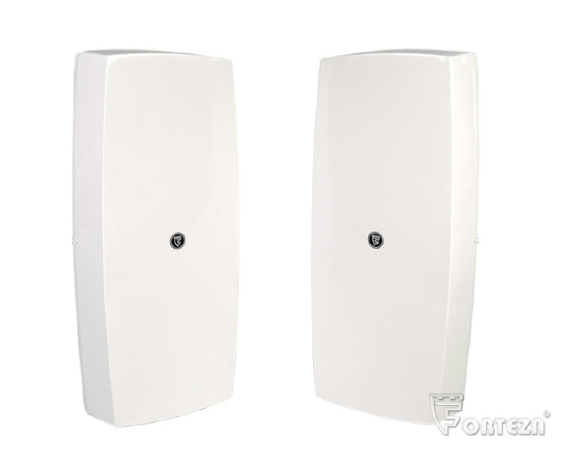
The detectors are resistant to rain, snow, fog, lightning, ice, solar radiation, power line fields (up to 500 kV), vegetation, small birds and animals. The use of 8-frequency letters eliminates light from adjacent sets of detectors. To control detectors and transmit alarm signals, both traditional dry relay contacts and USB, Bluetooth, RS-485 or Ethernet interfaces are used.
FlexZone Processing Unit (PU)
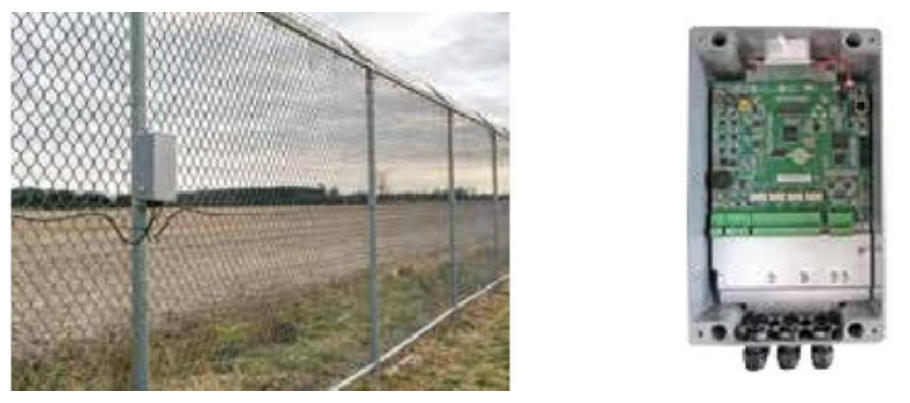
Allows:
- detect intrusion sites with an accuracy of ± 6 m at a distance of up to 300 m in both directions from the processing unit (600 m in total);
- simultaneously detect multiple intruders at a distance of 15 m from each other;
- locations of violations are displayed on an electronic map of the facility;
- used for perimeter security at road checkpoints.
Conclusion
Reliable security of customs clearance points at railway stations is possible with comprehensive integration of a perimeter security system and a video surveillance system.